


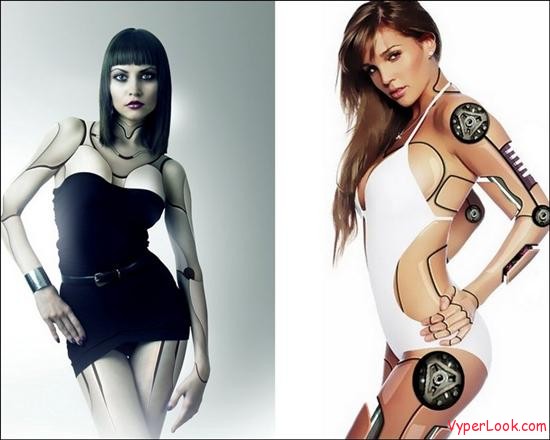
"My forecast is that around 2050, the state of Massachusetts will be the first jurisdiction to legalize marriages with robots," artificial intelligence researcher David Levy at the University of Maastricht in the Netherlands told LiveScience.
Levy recently completed his Ph.D. work on the subject of human-robot relationships, covering many of the privileges and practices that generally come with marriage as well as outside of it.
At first, sex with robots might be considered geeky, "but once you have a story like 'I had sex with a robot, and it was great!' appear someplace like Cosmo magazine, I'd expect many people to jump on the bandwagon," Levy said.
Pygmalion to Roomba
The idea of romance between humanity and our artistic and/or mechanical creations dates back to ancient times, with the Greek myth of the sculptor Pygmalion falling in love with the ivory statue he made named Galatea, to which the goddess Venus eventually granted life.
This notion persists in modern times. Not only has science fiction explored this idea, but 40 years ago, scientists noticed that students at times became unusually attracted to ELIZA, a computer program designed to ask questions and mimic a psychotherapist.
• Click here for FOXNews.com's Patents and Innovation Center.
"There's a trend of robots becoming more human-like in appearance and coming more in contact with humans," Levy said. "At first robots were used impersonally, in factories where they helped build automobiles, for instance. Then they were used in offices to deliver mail, or to show visitors around museums, or in homes as vacuum cleaners, such as with the Roomba. Now you have robot toys, like Sony's Aibo robot dog, or Tickle Me Elmos, or digital pets like Tamagotchis."
In his thesis, "Intimate Relationships with Artificial Partners," Levy conjectures that robots will become so human-like in appearance, function and personality that many people will fall in love with them, have sex with them and even marry them.
"It may sound a little weird, but it isn't," Levy said. "Love and sex with robots are inevitable."
Sex in 5 years
Levy argues that psychologists have identified roughly a dozen basic reasons why people fall in love, "and almost all of them could apply to human-robot relationships. For instance, one thing that prompts people to fall in love are similarities in personality and knowledge, and all of this is programmable. Another reason people are more likely to fall in love is if they know the other person likes them, and that's programmable too."
In 2006, Henrik Christensen, founder of the European Robotics Research Network, predicted that people will be having sex with robots within five years, and Levy thinks that's quite likely.
There are companies that already sell realistic sex dolls, "and it's just a matter of adding some electronics to them to add some vibration," he said, or endowing the robots with a few audio responses. "That's fairly primitive in terms of robotics, but the technology is already there."
As software becomes more advanced and the relationship between humans and robots becomes more personal, marriage could result.
"One hundred years ago, interracial marriage and same-sex marriages were illegal in the United States. Interracial marriage has been legal now for 50 years, and same-sex marriage is legal in some parts of the states," Levy said. "There has been this trend in marriage where each partner gets to make their own choice of who they want to be with."
"The question is not if this will happen, but when," Levy said. "I am convinced the answer is much earlier than you think."
When and where it'll happen
Levy predicts Massachusetts will be the first jurisdiction to legalize human-robot marriage.
"Massachusetts is more liberal than most other jurisdictions in the United States and has been at the forefront of same-sex marriage," Levy said. "There's also a lot of high-tech research there at places like MIT."
Although roboticist Ronald Arkin at the Georgia Institute of Technology in Atlanta does not think human-robot marriages will be legal anywhere by 2050, "anything's possible. And just because it's not legal doesn't mean people won't try it," he told LiveScience.
"Humans are very unusual creatures," Arkin said. "If you ask me if every human will want to marry a robot, my answer is probably not. But will there be a subset of people? There are people ready right now to marry sex toys."
The main benefit of human-robot marriage could be to make people who otherwise could not get married happier, "people who find it hard to form relationships, because they are extremely shy, or have psychological problems, or are just plain ugly or have unpleasant personalities," Levy said. "Of course, such people who completely give up the idea of forming relationships with other people are going to be few and far between, but they will be out there."
Ethical questions
The possibility of sex with robots could prove a mixed bag for humanity. For instance, robot sex could provide an outlet for criminal sexual urges.
"If you have pedophiles and you let them use a robotic child, will that reduce the incidence of them abusing real children, or will it increase it?" Arkin asked. "I don't think anyone has the answers for that yet — that's where future research needs to be done."
Keeping a robot for sex could reduce human prostitution and the problems that come with it.
However, "in a marriage or other relationship, one partner could be jealous or consider it infidelity if the other used a robot," Levy said. "But who knows, maybe some other relationships could welcome a robot. Instead of a woman saying, 'Darling, not tonight, I have a headache,' you could get 'Darling, I have a headache, why not use your robot?'"
Arkin noted that "if we allow robots to become a part of everyday life and bond with them, we'll have to ask questions about what's going to happen to our social fabric. How will they change humanity and civilization? I don't have any answers, but I think it's something we need to study. There's a real potential for intimacy here, where humans become psychologically and emotionally attached to these devices in ways we wouldn't to a vibrator."
Levy is currently writing a paper on the ethical treatment of robots. When it comes to sex and love with robots, "the ethical issues on how to treat them are something we'll have to consider very seriously, and they're very complicated issues," Levy said.


.gif)


