Jobs for animators

All the 70% UniqueRobots visitors got jobs in international companies and we proudly say that uniquerobots had the specatacular content about animation and animation schools and also about animation courses

Robotics

Here Unique means unique="Differnt" and Robots="Robots" here we have a perfect view on robots and we proudly say that main theme of this Uniquerobots site is about robots and here our vistiors know the all types of robots and about future technology

Human psycology

uniquerobots has a wonderful content on human psycology and about how that has to lead his own life and also has wonderful premium e-books for free download and had a lots of tips and techninques on how to learn a man

Future Vehicls

uniquerobots proudly say that we got award on best aritcls on future cars and vehicls and we honestly say that uniquerobots cross the 1crore visitors

Nasa projects

All the upcoming projects of nasa will be first announce only on Uniquerobots. just check out uniquerobots for all future nasa projects and latest Techonlogy news on uniqerobots

welcome to the futute tech planet
Showing posts with label 2D animation. Show all posts

Choosing a 2D Animation School 0

Robo tech | 1:49 AM | ,


Choosing a 2D Animation School


Animation Training:


In terms of training, few actually get the "right" training. They go to a crash course program like Mesmer f/x (which teaches you about brand X software in 3 short weeks), put together a rather weak demo reel in the same timeframe, and then hit the streets looking for a job. These people, in my opinion, have no training at all because they know nothing of the art of animation, nothing about lighting, nothing about story telling. They just "think" they know the software. The majority of the failures occur amongst these individuals. Sound a little disheartening? It should. You are attempting to break into the film industry. You are just like an actor auditioning for a part. Everyone wants the part, you have to want it more than anyone else, so much so that they couldn't cast anyone else but you for the role.

If you go to a top quality and reputable school (and do _well_), your chances of getting your foot in the door for an interview increase ten-fold. The recruiters know what is taught at these schools and can assume that you are versed in a lot of things that most other candidates are not, but not always though. A person who has been trained in cinematology will stage their animations differently than those who have not. It's called framing a scene. Every scene or shot is framed so that it has the maximum impact on the audience in other woods, it tells a compelling story. Students of crash course programs tend to mimic what they've seen before, whether good or bad, which indicates a lack of creativity on their part. It's like copying the Mona Lisa and saying you did it. Yes, you may be able to technically copy something, but without the original there for you to work from, would you be able to paint it on your own? There are a lot of choices to be made...what canvas to use, what medium, what hues, what pose...a lot of questions. Granted you won't be responsible for every question hat needs to be answered, but you will have to be consciously aware of them. That's the difference between a good education and an adequate one.

There are no guarantees in this business. It's one part talent and two parts part luck. The old axiom "It's not what you know, but who you know" rings true here. Once you get into the biz, you're over the biggest hump. From then on, you're one of the players who move from one studio to the next, looking for a better job opportunity. But you have to survive that first spring cut to do it. Some people find work but can't keep up with the pace. They end up burning out or getting fired. These companies are looking for the best, and you'll have to stay on top if you want to work for the big boys like ILM, Disney, or Pixar.

Animation Schools and Colleges:


School is very expensive. You can expect to spend about 6K for a crash course in animation as well, but I highly advise against attending such programs for the above mentioned reasons. You get what you pay for. Private schools such as Ringling, Sheridan, etc. will cost you a lot more than state run schools (like twice as much or more!). They're a bit more picky about who they accept and pride themselves in producing top quality graduates. They not in the business of making sure "X" number of students graduate each year, they have their reputations to uphold...hence the dramatic increase in the quality of the education. You will most likely be paying out of state tuition at one of these schools, but federal aid is available to you at most accredited institutions, so always look into that before you choose school "A" over school "B". I'm not about to suggest that you can't find the education that you want where you live, the education curriculums change all the time and more and more schools are offering Animation programs. Just be sure that the school you attend is the right one for you, because in all likely-hood, you won't be able to afford another education at another school after that. A lot of information on different schools is now available on the Net. Check 'em out. 

Demo Reels and Choosing a School:


Demo reels should be done while in school. That's something you'll want to check out. Some places provide no means for putting student's work to tape! Avoid these places, as digital to video transfer can cost a fortune! It also shows that they aren't as "hip" to the business as they claim to be. Also understand that a good demo reel takes more than a couple days to put together. Good work takes time. Some folks spend years refining their reels.

If you interested in Animation, then don't go to a school that _doesn't_ offer a program in Animation, electives don't count. A lot of schools offer electives in using animation software, and that's not the same thing as being educated in Animation.

Get in contact with schools and ask for a free info packet, they should be more than happy to provide you with one and this will give you a good opporunity to see what they offer and teach. If you can, visit these schools and get in touch with former students. There's nothing like seeing a school first hand and touring the facilities, but if you can't do that, contacting former students will give you a good idea of what the school is like. Just make sure you talk to more than one person...different people have different experiences! 

concept art 0

Robo tech | 1:47 AM | ,


Concept Art


Tell us about yourself Aaron; where are you from and when and how did you get started drawing concept art?
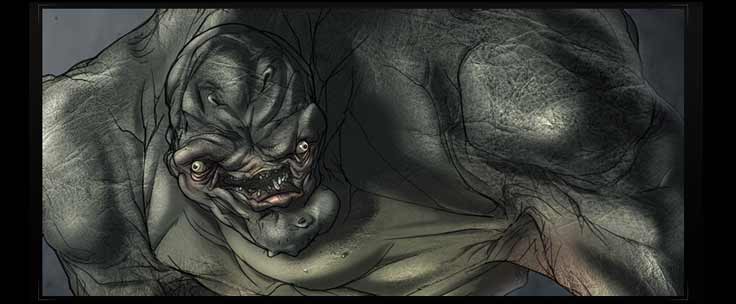
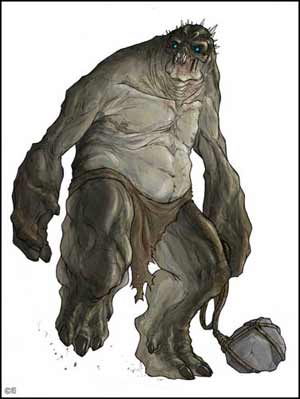
I'm from Vancouver, British Columbia, Canada. I decided I wanted to do concept art in high school around grade 9 or 10. Basically I watched a lot of movies, such as Jurassic Park, and Aliens. Those films really made me want to design my own characters and creatures so one day I could see them on the big screen.

How serious are you about concept art? Is it a career for you or is it just a hobby? 
I'm very serious about concept art as my career choice. I can't think of anything I'd rather do more, so it's a bonus that I can actually make a living off of it.
Do you ever animate any of your concept drawings? If so what software do you use?>
No, I don't animate any of my artwork. I do, however, try to make my designs feasible for animation, whether it's 2D or 3D. Since I have experience with both forms of animation, it helps me to figure out what will work and what won't when I'm designing.

Do you think that artists with a formal education in Illustration have an advantage over self-taught artists?
I think that's true to some degree. Formal education is definitely helpful, as I found out with life drawing. Figure studies and practicing drawing the human form really taught me to loosen up, and was probably the biggest aid towards helping my skills improve. Teachers often have a lot of helpful insight. On the other hand, a lot of my own knowledge is based off self-taught observation of other artwork and designs, as well as nature and other things such as architecture and such.
It's good to teach yourself as much as possible, but definitely important to learn the technical side of art.

What Programs and Hardware do currently work with? And why do you choose to work with these software packages? 
I work with natural media (paper, pencils, pens) for all my drawing, and Adobe Photoshop 7 for my coloring. I've used other programs, but Photoshop is definitely the best suited to my style. I've been teaching myself how to paint with Photoshop for the past 3 years, and have grown really familiar with the program. This is good, since I like to work quickly and it saves me a lot of time if I know exactly what I'm doing.

What artists influenced your work and whom do you admire?
Most of the artists who inspire me are fellow designers in the entertainment industry. People such as Mark McCreery, Sam Liu, Mike Yamada, and Feng Zhu create wonderful art which really motivates me to improve. I've had the chance to interact with a few of these people, which is definitely an insightful experience when it comes to learning about how they work.

Where do you get the inspiration for your art?
I find inspiration in a lot of things when I'm designing. The biggest inspiration, though, is definitely movies. Every time I come out of just seeing a big blockbuster film with a lot of cool imagery and design, I get really pumped up about creating some of my own. Other inspirations can be found in other places, such as nature, or even interesting buildings in the city. I've come up with a few fun ideas after watching wildlife shows on television.


Could you take us through your creative process when starting a new project.
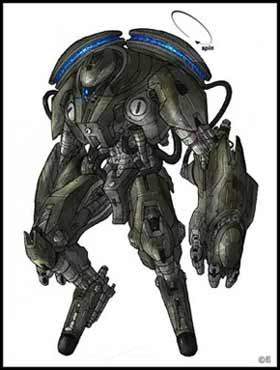
Basically I start off with the goal to create something original. Originality is definitely the key word. Even if the basic idea behind the concept isn't very fresh, say, a mech with guns or a barbarian with a sword, I'll try to add some sort of stylistic twist to it, to give it that edge which will set it apart. Often I look into other designs related to what I'm working on, to research what has been done, what works, what doesn't, etc. After that, I'll draw a bunch of rough sketches to practice fleshing out the idea I have in my head. Once I settle on the look of the design, it's just a matter of putting it on paper and getting it done.

How often do you draw?
I try draw almost every day, whether it's a just 5 minute thumbnail doodle, or a completed design.
What artistic media do you prefer to work in and there any that you don't like to use? 
I definitely prefer pencils and paper over any other medium. It's really a lot more hands-on than working with a computer, and I find it really captures the artist's style. That's always a good thing. I've never been a big fan of painting with a brush on paper or canvas, but I do plan on venturing into that direction somewhere down the road. I'm sure I'll have a lot of fun learning new techniques and such.

What's the most technically challenging aspect of your drawing style? 
I try to create a level of realism in my designs which will make people think that it really can exist and function in the real world. This is definitely the most challenging part of coming up with a design, since people are so accustomed to knowing what looks right or what looks wrong. Even if the design is outrageously strange, I'll try hard to make it based in some sort of working reality.

What three pieces of your artwork are you most proud of and why?
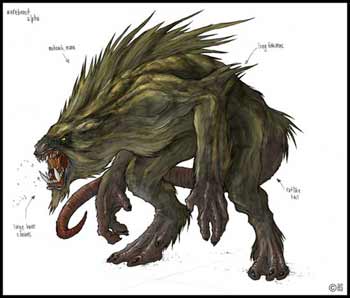
I'm pretty picky about my own art, so it's difficult to pick any favourites. If I had to name a top three, they would be Bunchies, Godo, and the Scythemaw. Bunchies was just a quick character design I had done at 4am which eventually became insanely popular. It eventually spread all over the internet and I still get mail about it. Godo is a character design I had done for a contest on CGTalk.com, which won me 1st place. I'm still pretty happy with it. Lastly, the Scythemaw is a creature design where I drew out various parts of the life cycle. I like how it turned out, and I think I came up with a pretty cohesive and scary design.

On average how long does it take you to complete a concept? 
This can definitely vary. Sometimes I'll spend 2-3 days re-drawing an idea and finding technical problems that take a lot of time to solve. Other times, I'll start a new concept and be finished within 2 hours. It can be a good learning experience when you struggle with a design, but it's definitely satisfying when you can get a lot of good work done quickly. Thankfully, I'm getting quicker everyday.
Is there anything you'd like to work on if you had the chance? 
I'd love to work on any big budget action movie, especially one featuring cool monsters. It would be very, very cool to get the chance to work with someone like Stan Winston or Phil Tippett on a project someday. Hopefully I'll get the chance soon.

What's next for Aaron St. Goddard? Are there any new projects on the horizon? 
At the moment I'm trying to lean towards getting full-time employment instead of freelance work. Freelance is fun, but I'd definitely like to work with a team of people on a cool project.

Do you have any advice for the aspiring artist out there? 
>There's a few important things to know. One of the most important things is to get your name out there. Make contacts. If you want people to know who you are, post your work on forums and advertise your website/portfolio if you have one. Also, be open to critique. The best way to improve is to find out what you may be doing wrong, and fixing it. Other artists can help you out a great deal. Lastly, draw as often as you can, and focus on making a diverse portfolio. It'll pay off in the end.


Thanks to Aaron St. Goddard (http://www.wildpixels.com/brasshorse/) for agreeing to answer the questions we had for him.
  

character animation books 0

Robo tech | 1:44 AM | , ,


Character Animation Books


Timing for Animation
by Harold Whitaker and John Halas

Prefaced by John Lasseter:

"The principles of timing laid out in this book are more applicable (now) than ever before." 
The Animator's Survival Kit
by Richard Williams

The definitive book on animation, from the Academy Award-winning animator behind Who Framed Roger Rabbit?
Cartoon Animation (The Collector's Series)
by Preston Blair 

" I've been in or near the cartoon business for 50 years and Preston Blair's "Cartoon Animation" played a big role in my education. " (view it on-line : www.freetoon.com) 
Cartoon Animation (How to Draw and Paint series)
by Preston Blair

Walter Foster's classic How to Draw and Paint series provides aspiring artists with an exceptional array of art instruction booksfeaturing all subject areas and media. Each title includes easy step-by-step exercises as well as finished illustrations or paintings that will inspire artistic talent in anyone. 
Acting for Animators
by Ed Hooks, Brad Bird, Mike Caputo (Illustrator)

Acting for Animators covers a lot of ground that doesn't get addressed much in animation school. Sure, we're all told to make the character "live and breathe", but most of the info that follows that admonition is from an art perspective. Hooks draws on his acting training and experience to give a different set of tools animators can use to reach that goal. The information on psychological gestures alone is worth the cost of the book (there's something you don't hear about in your Maya classes). 
The Illusion of Life: Disney Animation
by Frank Thomas, Ollie Johnston (Contributor), Cllie Johnston

Equivalent to a Holy relic, this masterpiece of a book has inspired me, not only to appreciate Disney's work, but also the animators and animation in general. If you are considering entering the animation field, in particular working for Disney, then by all means purchase this book and read it thouroughly. 2 of the Old Nine Men, Ollie Johnston and Frank Thomas, wrote this book sometime in the early eighties. 
The Animator's Workbook
by Tony White

This book is one of the best all round books used to learn animation techniques; a perfect text for teachers. Animation techniques are illuminated from squash and stretch, to stop action puppet, to cell painting. Included is a great reference section for finding unique materials and building your own animation stand. This is more than a simple how to do manual. It is a companion to any future artist animator for it opens the reader to the sophisticated path of animation as tool articulate movements rather than simply as a squash and stretch manipulator of cartoon characters. 
Animation from Script to Screen
by Shamus Culhane

Shamus Culhane is one of the world's best animators. He created the walk cycle of the seven dwarfs in snow white. He demonstrated each characters personality walking in a line. All the characters are in synch. Amazing. He explains the basics of animation. This book is a great way to understand the techniques of hand drawn animation

principles of animation 0

Robo tech | 1:41 AM | , ,


Principles of Animation


28 Principles of Animation

This article was given to me by Mark Kennedy (storyboard artist on Hercules and Tarzan). Thank you Mark for all those handouts!!
Often times animators and storyboarders in the industry are able to get handouts from some of the artists who are great teachers. This is an example of such kind of handout that gets circulated among the artists gradually. It took me quite a while to retype and scan the images from this handout. Please don't reproduce this on the internet without permission. (if you'd like to print it out and give it to another animation student, however, PLEASE do!) The entire article from here on out is by Walt Stanchfield (sp?) I included the images in approximately the same spot as they were on the original hand-written article.
This is a wonderful article for not only beginners but also for practiced animators. Please read it.

28 Principles of Animation

There are some principles of animation that can be consciously used in any scene. We should familiarize ourselves with them for both animation and animation-cleanup.

To illustrate these principles, I have chosen a supposedly simple scene. When the scene is analyzed, it is apparent how far one may go in using these principles.

The action in this scene is quite broad, making the principles easy to find, but they should be applied to subtle scenes also. Rarely in a picture is a character doing nothing- absolutely nothing. Snow White and Sleeping Beauty spend a short time in complete inactivity, but even then certain of these principles were used.

The use of held drawings and moving holds can be very effective, but only if they contain the vitality of an action drawing. Again, the use of these principles makes that possible.


28 Principles of Animation

  The purpose of studying and analyzing a scene like this is to acquaint oneself with the possibilites in the use of the principles of animation. I have listed 28 principles, though there well may be more. At first these will have to be used consciously, then hopefully in time will become second nature. These are the tools of animation and should be incorporated whenever possible. Some of them are accidentally stumbled upon while animating in an emotional spurt, but when the emotions are lax, knowing these principles will enable the artist to animate his scene intellectually, logically and artistically as well as emotionally. 


28 Principles of Animation

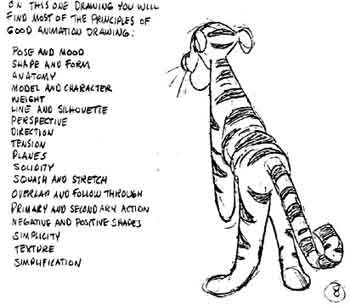
Here is a list of things (principles) that appear in these drawings, most of which should appear in all scenes, for they comprise the basis for full animation

-Pose and Mood
-Shape and Form
-Anatomy
-Model or Character
-Weight
-Line and Silhouette
-Action and Reaction
-Perspective
-Direction
-Tension

 -Planes
-Solidity
-Arcs
-Squash and Stretch
-Beat and Rythem
-Depth and Volume
-Overlap and followthru
-Timing
-Working from extreme to extreme

 -Straights and Curves
-Primary and secondary action
-Staging and composition
-Anticipation
-Caricature
-Details
-Texture
-Simplification
-Positive and negative shapes

28 Principles of Animation

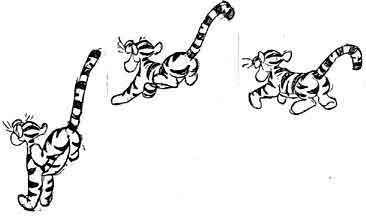
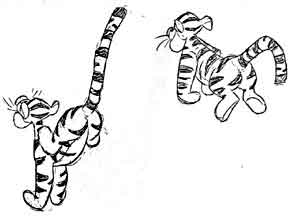
An example of the observations that might be made by flipping and studying just these two drawings. By shifting your eyes from one drawing to the other you can see these things happening. Watch the negative shapes also.


... To continue along this line of investigation...

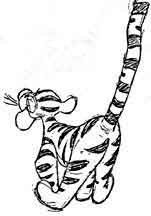
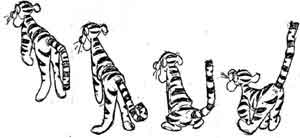
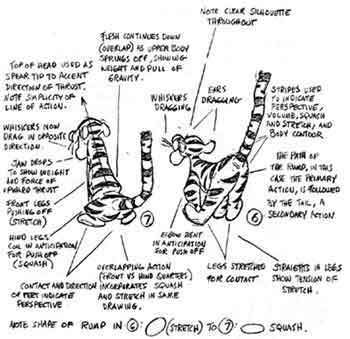
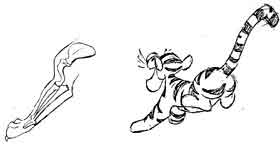
This drawing would be called the "push off". Note that every line and shape on the drawing helps the upward thrust. Even the tail, which is still following the path set up for it by its primary force, the rump, helps by way of contrast and followthrough. Pick any shape on the figure and compare it to drawing #6 on the preceding page. Note how each shape changes to enhance the overall shape and action: the neck, the chest, the legs, the back, etc.

Even though this is just one drawing, there is no doubt about the action that is taking place in this part of the scene. This should be true of any drawing in any scene.


Consider Anatomy Alone:

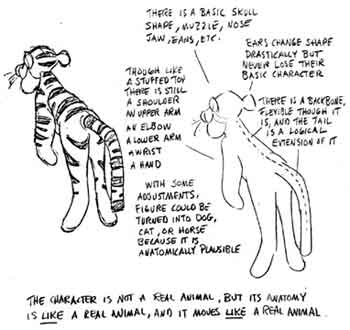
Aside from its purpose in the scene each drawing can be analyzed for different aspects of drawing. The whole body is a caracature of an animal, but all the parts of a real animal are present i.e., head, neck, back, hips, tail, etc. And each of them work and move in a plausible way.


Anatomy Continued

Anatomy, of course is essential to any drawing whether it has a direct reference to nature or is completely imaginary. Though a character and/or its action may be greatly exaggerated or caracatured, anatomy in a sense remains fairly constant. An elbow is an elbow and only bends in a certain way, and has its limitation. Liberties may be taken but the "reality" of even a cartoon must be kept or it will lose plausibility or credulity. It is not an easy thing to convert one's knowledge of structural anatomy to the cartoon medium.

It has been said that the location of a joint is more important than the joint itself. For instane if an arm shape has been established, it cannot have an elbow bend in an improbable place, no matter how well the elbow is drawn. Compare tiger's arm to that of a real tiger.


Consider Weight

The pull of gravity is one of the most important principles to deal with in animation. Everything has a certain amount of weight and will act and react accordingly. One easy way to lose the attention of an audience is to have feathers falling like bricks or bricks falling like feathers.

A certain humor can be gotten by bending the rules but should only be used where humor or special effect is called for. In shorts cartoons defying the laws of gravity, weight, speed, squash and stretch, etc., is a the rule of thumb. In Disney feature cartoons such flamboyant abandonment must be handled more discriminately.


future technology Copyright © 2010 Future tech is Designed by pavan Home | RSS Feed | Comment RSS