Jobs for animators

All the 70% UniqueRobots visitors got jobs in international companies and we proudly say that uniquerobots had the specatacular content about animation and animation schools and also about animation courses

Robotics

Here Unique means unique="Differnt" and Robots="Robots" here we have a perfect view on robots and we proudly say that main theme of this Uniquerobots site is about robots and here our vistiors know the all types of robots and about future technology

Human psycology

uniquerobots has a wonderful content on human psycology and about how that has to lead his own life and also has wonderful premium e-books for free download and had a lots of tips and techninques on how to learn a man

Future Vehicls

uniquerobots proudly say that we got award on best aritcls on future cars and vehicls and we honestly say that uniquerobots cross the 1crore visitors

Nasa projects

All the upcoming projects of nasa will be first announce only on Uniquerobots. just check out uniquerobots for all future nasa projects and latest Techonlogy news on uniqerobots

welcome to the futute tech planet
Showing posts with label future robos. Show all posts

Top 3 Psychology websites 0

Robo tech | 3:28 AM | , , , , , , , , ,


Top Psychology websites
After a great research on the internet about Psychology websites. I found these wonderful top psychology websites. These websites definitely useful for one who wants to learn psychology.
A list of top psychology websites
List of websites 1 to 3

1. PsychTronics: Psychtronics.com is the world’s leading Psychology website which contains all interesting topics about psychology and you need not to be a professional to understand the articles in psychtronics they are easy to understand to college students and one who loves psychology and want to learn psychology.
                 My suggestion is to follow psychtronics because all the articles in psychtronics are written by the professors and professionals of psychology universities.

2.Wikipedia

Wikipedia, the largest, free, multi-lingual encyclopedia on the web has great informative articles on a variety of subjects in psychology. From the history of psychology and methods of psychological research to its numerous sub-fields of study, Wikipedia is a continuously updated treasure trove of knowledge.
Each page you navigate to has a wealth of resources from people to publications, all organized in a structured fashion unique to Wikipedia.

3. WebMD Mental Health

WebMD’s Mental Health section has exhaustive information on disorders and treatment. It features Guide sections for specific disorders, with informative slideshows, latest news, and articles. All this is backed by the popular community section featuring blogs and message boards.

ExerciseBOts Personal Trainer Robot Promotes Healthy Lifestyle and Healthier Weight 0

Robo tech | 3:53 AM | , ,

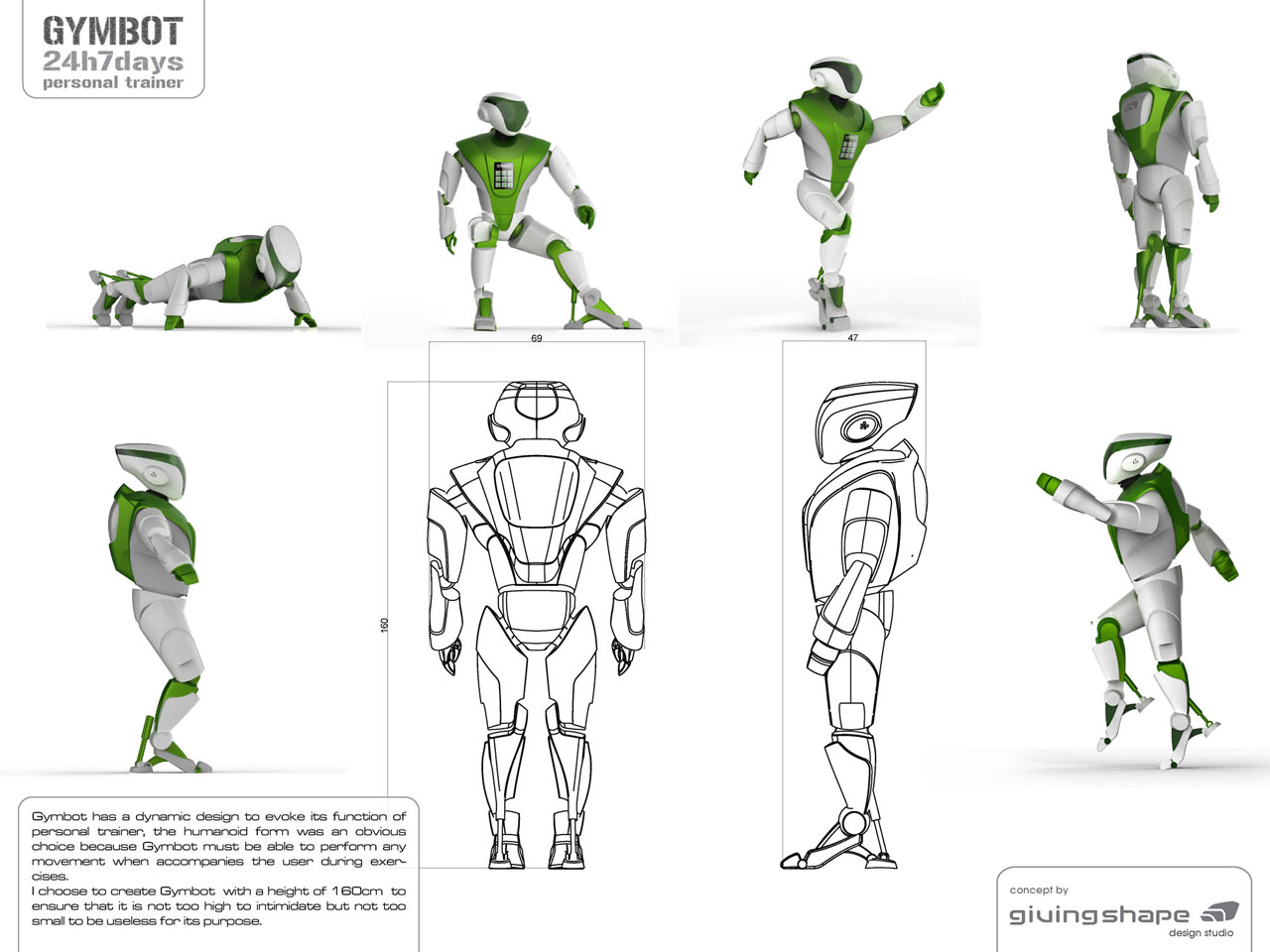
Presented at ICSR 2011 design award, Gymbot Personal Trainer Robot drew attention from many practitioners. Massimo Battaglia has come up with interesting scenario for the year of 2020 where obesity in developed countries would still be a big issue. Adults and young people do not maintain good balance between their body and food, they don’t actually care about their well being regardless they are aware of the problem. They don’t have the willpower to at least try to regain control of their lives, they prefer to use shortcuts which in the end are usually proven ineffective. Overweight is not only a health problem, it can also be an issue when it comes to social and working relationship.
There are solutions that promise you instant result, however nothing beats the strong will to have a healthy lifestyle. You will need a trainer that help you to control and correct your bad behaviors, give you the courage to keep your exercise routine to stay healthy and fit.
Designer : Massimo Battaglia
Gymbot Personal Trainer Robot by GivingShape

In the future, thank you to electric automotive industry, there will be great improvements in lithium batteries. They will be a lot smaller, durable and economic, thus making the robotic technologies become more advanced and affordable. Gymbot Personal Trainer Robot stays with you, 24 hours a day to teach you how to take a good care of yourself, on both food and physical side.
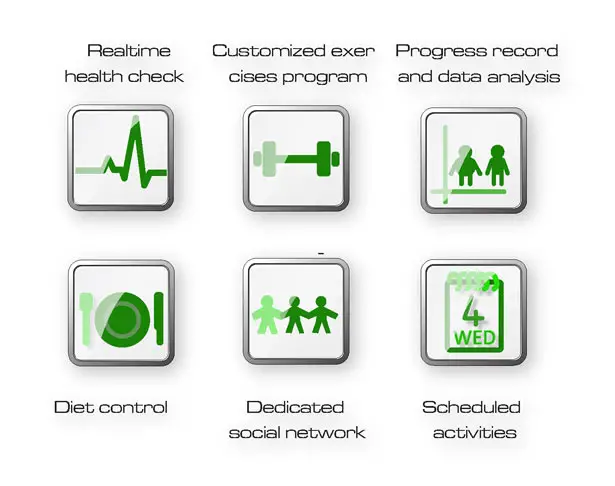
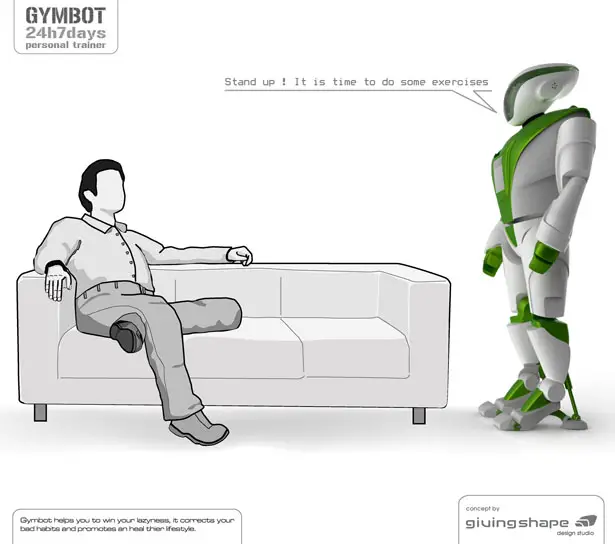
When you feel lazy, Gymbot Personal Trainer Robot will encourage you to do physical activity, just like a real personal trainer. This robot tracks your health record to tailor a physical activity program that suit you best, this robot will show you how to do the exercise properly. This robot is more than just your personaltrainer, Gymbot evaluates your pulse and health in real time to prevent any undue stress.
Gymbot Personal Trainer Robot has the ability to quantify your progress and is able to understand what and how much you should eat in order to give advice on proper diet. This robot is an innovative approach to prevent many health issues, it can help you to tackle your laziness, it corrects your bad habits.
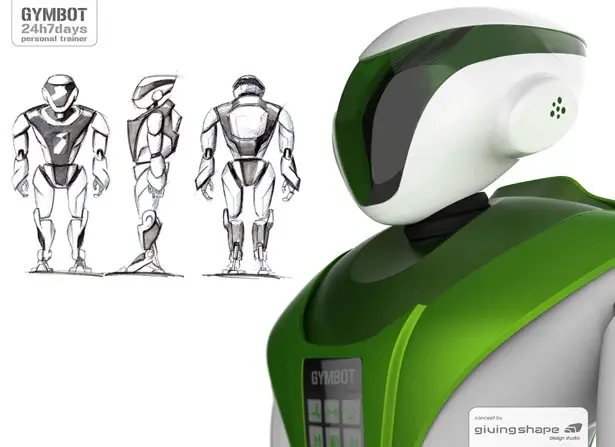
Gymbot Personal Trainer Robot by GivingShape
Click above image for bigger view
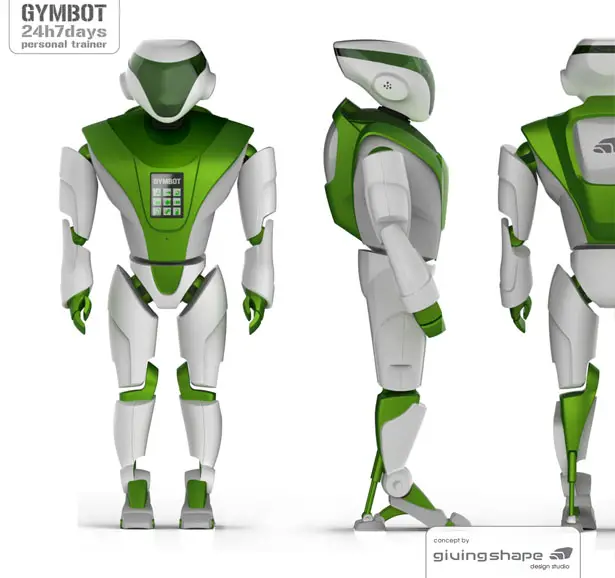
Gymbot Personal Trainer Robot by GivingShape
Click above image for bigger view
Gymbot Personal Trainer Robot technical description:
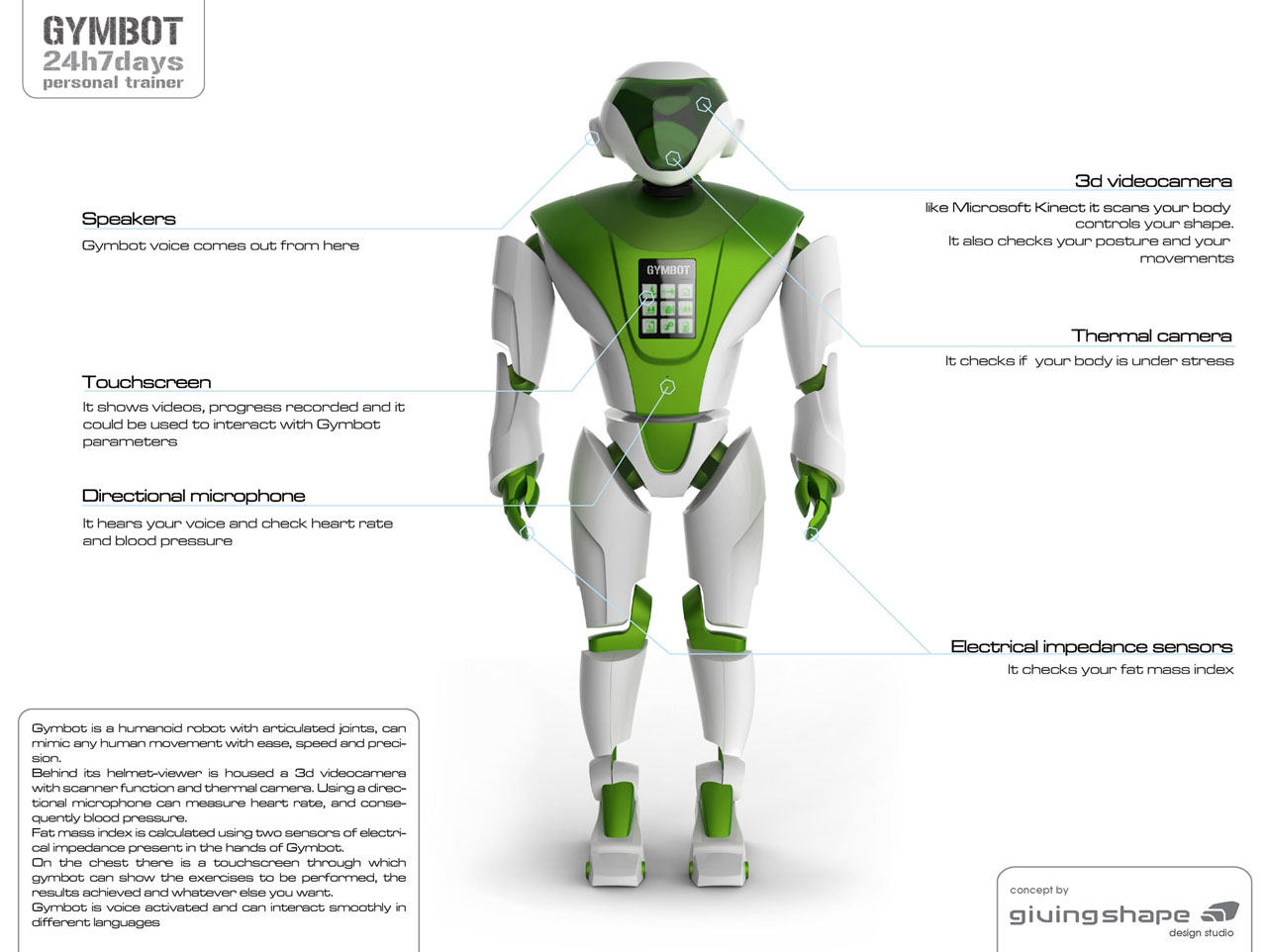
Gymbot is a humanoid robot with articulated joints that mimics any human movement with ease, speed and precision. Behind its helmet-viewer there’s a 3D video camera with scanner function and thermal camera. Using a directional microphone, this robot can measure heart rate, and consequently blood pressure.
Fat mass index is calculated using two sensors of electrical impedance present on the hands of Gymbot. On the chest there is a touchscreen through which Gymbot can show the exercises to be performed, the results achieved and whatever else you want.
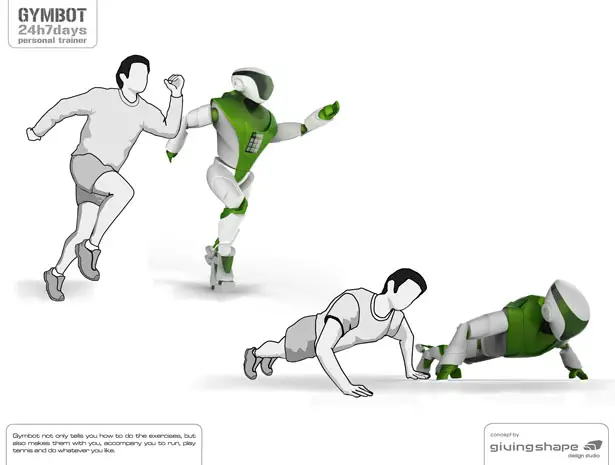
Gymbot Personal Trainer Robot is voice activated and can interact smoothly in different languages. It has a dynamic design to evoke its function of personal trainer, the humanoid form was an obvious choice because Gymbot must be able to perform any movement when accompanies the user during exercises.

Sex and Marriage With Robots by 2050 0

Robo tech | 2:50 AM | ,

Humans could marry robots within the century. And consummate those vows.

"My forecast is that around 2050, the state of Massachusetts will be the first jurisdiction to legalize marriages with robots," artificial intelligence researcher David Levy at the University of Maastricht in the Netherlands told LiveScience.

Levy recently completed his Ph.D. work on the subject of human-robot relationships, covering many of the privileges and practices that generally come with marriage as well as outside of it.

At first, sex with robots might be considered geeky, "but once you have a story like 'I had sex with a robot, and it was great!' appear someplace like Cosmo magazine, I'd expect many people to jump on the bandwagon," Levy said.

Pygmalion to Roomba

The idea of romance between humanity and our artistic and/or mechanical creations dates back to ancient times, with the Greek myth of the sculptor Pygmalion falling in love with the ivory statue he made named Galatea, to which the goddess Venus eventually granted life.

This notion persists in modern times. Not only has science fiction explored this idea, but 40 years ago, scientists noticed that students at times became unusually attracted to ELIZA, a computer program designed to ask questions and mimic a psychotherapist.

• Click here for FOXNews.com's Patents and Innovation Center.

"There's a trend of robots becoming more human-like in appearance and coming more in contact with humans," Levy said. "At first robots were used impersonally, in factories where they helped build automobiles, for instance. Then they were used in offices to deliver mail, or to show visitors around museums, or in homes as vacuum cleaners, such as with the Roomba. Now you have robot toys, like Sony's Aibo robot dog, or Tickle Me Elmos, or digital pets like Tamagotchis."

In his thesis, "Intimate Relationships with Artificial Partners," Levy conjectures that robots will become so human-like in appearance, function and personality that many people will fall in love with them, have sex with them and even marry them.

"It may sound a little weird, but it isn't," Levy said. "Love and sex with robots are inevitable."

Sex in 5 years

Levy argues that psychologists have identified roughly a dozen basic reasons why people fall in love, "and almost all of them could apply to human-robot relationships. For instance, one thing that prompts people to fall in love are similarities in personality and knowledge, and all of this is programmable. Another reason people are more likely to fall in love is if they know the other person likes them, and that's programmable too."

In 2006, Henrik Christensen, founder of the European Robotics Research Network, predicted that people will be having sex with robots within five years, and Levy thinks that's quite likely.

There are companies that already sell realistic sex dolls, "and it's just a matter of adding some electronics to them to add some vibration," he said, or endowing the robots with a few audio responses. "That's fairly primitive in terms of robotics, but the technology is already there."

As software becomes more advanced and the relationship between humans and robots becomes more personal, marriage could result.

"One hundred years ago, interracial marriage and same-sex marriages were illegal in the United States. Interracial marriage has been legal now for 50 years, and same-sex marriage is legal in some parts of the states," Levy said. "There has been this trend in marriage where each partner gets to make their own choice of who they want to be with."

"The question is not if this will happen, but when," Levy said. "I am convinced the answer is much earlier than you think."

When and where it'll happen

Levy predicts Massachusetts will be the first jurisdiction to legalize human-robot marriage.

"Massachusetts is more liberal than most other jurisdictions in the United States and has been at the forefront of same-sex marriage," Levy said. "There's also a lot of high-tech research there at places like MIT."

Although roboticist Ronald Arkin at the Georgia Institute of Technology in Atlanta does not think human-robot marriages will be legal anywhere by 2050, "anything's possible. And just because it's not legal doesn't mean people won't try it," he told LiveScience.

"Humans are very unusual creatures," Arkin said. "If you ask me if every human will want to marry a robot, my answer is probably not. But will there be a subset of people? There are people ready right now to marry sex toys."

The main benefit of human-robot marriage could be to make people who otherwise could not get married happier, "people who find it hard to form relationships, because they are extremely shy, or have psychological problems, or are just plain ugly or have unpleasant personalities," Levy said. "Of course, such people who completely give up the idea of forming relationships with other people are going to be few and far between, but they will be out there."

Ethical questions

The possibility of sex with robots could prove a mixed bag for humanity. For instance, robot sex could provide an outlet for criminal sexual urges.

"If you have pedophiles and you let them use a robotic child, will that reduce the incidence of them abusing real children, or will it increase it?" Arkin asked. "I don't think anyone has the answers for that yet — that's where future research needs to be done."

Keeping a robot for sex could reduce human prostitution and the problems that come with it.

However, "in a marriage or other relationship, one partner could be jealous or consider it infidelity if the other used a robot," Levy said. "But who knows, maybe some other relationships could welcome a robot. Instead of a woman saying, 'Darling, not tonight, I have a headache,' you could get 'Darling, I have a headache, why not use your robot?'"

Arkin noted that "if we allow robots to become a part of everyday life and bond with them, we'll have to ask questions about what's going to happen to our social fabric. How will they change humanity and civilization? I don't have any answers, but I think it's something we need to study. There's a real potential for intimacy here, where humans become psychologically and emotionally attached to these devices in ways we wouldn't to a vibrator."

Levy is currently writing a paper on the ethical treatment of robots. When it comes to sex and love with robots, "the ethical issues on how to treat them are something we'll have to consider very seriously, and they're very complicated issues," Levy said.

A brief history of female robots: from maria to E.M.A. 0

Robo tech | 4:44 AM |


science fiction has always played a role in contemplating the future and allowing us to stretch our imaginations. 
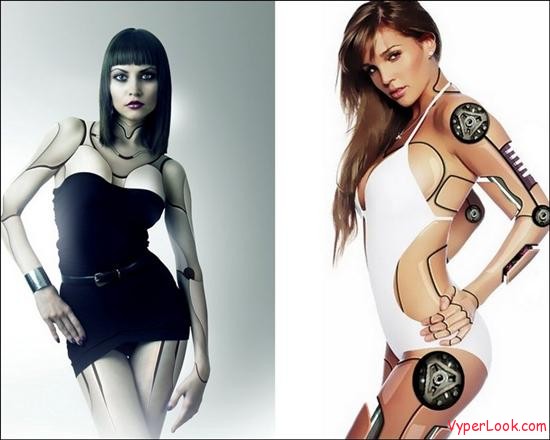
the idea of robots has long been around, but the introduction of the female robot was something that came
about during the 1920's. often used in hollywood as a seductress, the fembot has been making her way from 
sci-fi fantasy screenplay to the real-life. fembots have been designed as a sex dolls, receptioinsts even 
a police chief. the following pages are a timeline of female robots in history, from fritz lang's destructive maria 
to the affectionate E.M.A.(eternal maiden actulization).
Eternal maiden actualization (E.M.A.) by SEGA toys (2008)


This past june, SEGA toys announced the release of E.M.A. projected for sale by september 2008.
she is essentially a femisapien which was produced by wowwee in 1996, only E.M.A. is targeted
towards the japanese. the newest fembot on the market, E.M.A. was made with the intention of
providing sex appeal with a womanly body that can move at the elbows, shoulders, waist and knees.
made to act like a 'real girlfriend', E.M.A. can sing, dance and has a 'love' sensor for kissing. if you put
your face close enough to hers, she will give you a few pecks. standing at 38 cm tall, she is programmed
to introduce herself, hand-out business cards, strut like a lady and if you're lucky, she'll fall into love mode
and rest-up to you for a little cuddle.


NASA to Launch Human-Like Robot to Join Space Station Crew 0

Robo tech | 5:05 AM |

NASA will launch the first human-like robot to space later this year to become a permanent resident of the International Space Station. Robonaut 2, or R2, was developed jointly by NASA and General Motors under a cooperative agreement to develop a robotic assistant that can work alongside humans, whether they are astronauts in space or workers at GM manufacturing plants on Earth.

The 300-pound R2 consists of a head and a torso with two arms and two hands. R2 will launch on space shuttle Discovery as part of the STS-133 mission planned for September. Once aboard the station, engineers will monitor how the robot operates in weightlessness.

R2 will be confined to operations in the station's Destiny laboratory. However, future enhancements and modifications may allow it to move more freely around the station's interior or outside the complex.

"This project exemplifies the promise that a future generation of robots can have both in space and on Earth, not as replacements for humans but as companions that can carry out key supporting roles," said John Olson, director of NASA's Exploration Systems Integration Office at NASA Headquarters in Washington. "The combined potential of humans and robots is a perfect example of the sum equaling more than the parts. It will allow us to go farther and achieve more than we can probably even imagine today."

The dexterous robot not only looks like a human but also is designed to work like one. With human-like hands and arms, R2 is able to use the same tools station crew members use. In the future, the greatest benefits of humanoid robots in space may be as assistants or stand-in for astronauts during spacewalks or for tasks too difficult or dangerous for humans. For now, R2 is still a prototype and does not have adequate protection needed to exist outside the space station in the extreme temperatures of space.

Testing the robot inside the station will provide an important intermediate environment. R2 will be tested in microgravity and subjected to the station's radiation and electromagnetic interference environments. The interior operations will provide performance data about how a robot may work side-by-side with astronauts. As development activities progress on the ground, station crews may be provided hardware and software to update R2 to enable it to do new tasks.

R2 is undergoing extensive testing in preparation for its flight. Vibration, vacuum and radiation testing along with other procedures being conducted on R2 also benefit the team at GM. The automaker plans to use technologies from R2 in future advanced vehicle safety systems and manufacturing plant applications.

"The extreme levels of testing R2 has undergone as it prepares to venture to the International Space Station are on par with the validation our vehicles and components go through on the path to production," said Alan Taub, vice president of GM's global research and development. "The work done by GM and NASA engineers also will help us validate manufacturing technologies that will improve the health and safety of our GM team members at our manufacturing plants throughout the world. Partnerships between organizations such as GM and NASA help ensure space exploration, road travel and manufacturing can become even safer in the future." 


NASA, GM Take Giant Leap in Robotic Technology 0

Robo tech | 5:01 AM |


Robonaut is evolving.

NASA and General Motors are working together to accelerate development of the next generation of robots and related technologies for use in the automotive and aerospace industries.

Engineers and scientists from NASA and GM worked together through a Space Act Agreement at the agency's Johnson Space Center in Houston to build a new humanoid robot capable of working side by side with people. Using leading edge control, sensor and vision technologies, future robots could assist astronauts during hazardous space missions and help GM build safer cars and plants.

The two organizations, with the help of engineers from Oceaneering Space Systems of Houston, developed and built the next iteration of Robonaut. Robonaut 2, or R2, is a faster, more dexterous and more technologically advanced robot. This new generation robot can use its hands to do work beyond the scope of prior humanoid machines. R2 can work safely alongside people, a necessity both on Earth and in space.

"This cutting-edge robotics technology holds great promise, not only for NASA, but also for the nation," said Doug Cooke, associate administrator for the Exploration Systems Mission Directorate at NASA Headquarters in Washington. "I'm very excited about the new opportunities for human and robotic exploration these versatile robots provide across a wide range of applications."


"For GM, this is about safer cars and safer plants," said Alan Taub, GM's vice president for global research and development. "When it comes to future vehicles, the advancements in controls, sensors and vision technology can be used to develop advanced vehicle safety systems. The partnership's vision is to explore advanced robots working together in harmony with people, building better, higher quality vehicles in a safer, more competitive manufacturing environment."

The idea of using dexterous, human-like robots capable of using their hands to do intricate work is not new to the aerospace industry. The original Robonaut, a humanoid robot designed for space travel, was built by the software, robotics and simulation division at Johnson in a collaborative effort with the Defense Advanced Research Project Agency 10 years ago. During the past decade, NASA gained significant expertise in building robotic technologies for space applications. These capabilities will help NASA launch a bold new era of space exploration.

"Our challenge today is to build machines that can help humans work and explore in space," said Mike Coats, Johnson's center director. "Working side by side with humans, or going where the risks are too great for people, machines like Robonaut will expand our capability for construction and discovery."

NASA and GM have a long, rich history of partnering on key technologies, starting in the 1960s with the development of the navigation systems for the Apollo missions. GM also played a vital role in the development of the Lunar Rover Vehicle, the first vehicle to be used on the moon. 

different kinds of robos 0

Robo tech | 2:08 AM |

There are numerous ways how to define types of robots. As I have seen the possible divisions varies widely. The main reason of these differences is that different scholars tend to have different views on issues that should be taught under term "robotics".

For example - most scholars that teach robotics usually focus mainly on industrial robots, neglecting service robots completely. Therefore when talking about types of robots they usually talk about types of industrial robots. There is a strong reason for this though - the vast majority of robotics engineers will have to deal mostly with industrial robotics.
Nevertheless, industrial robots are not the only ones. Therefore when dividing robots into types this division should be broad enough to include everything that can be understood as a robot.
There are two possible ways how this could be done. First, you can divide robots into types by their application and second - by the way they move (or doesn't). I acknowledge that there are other possible ways how to define various types of robots but in my opinion these two are the most relevant ones. Also, I prefer to use both these classifications together. This way two questions about a robot would be already answered - "What it does?" and "How it does its job?"

Types of robots by application

Nowadays, robots do a lot of different tasks in many fields. And this number of jobs entrusted to robots is growing steadily. That's why one of the best ways how to divide robots into types is a division by their application.There are:

*Industrial robots

*Domestic or household robots

*Medical robots

*Service robots
*Military robots

*Entertainment robots

*Exploration robots
Now, as you can see there are examples that fit into more than one of these types. For example, there can be a deep see exploration robot that can gather some valuable information that can be used for military purposes.
Also, I have seen that a division into two types is used, accordingly - industrial and service robots. However, I can not see how a Mars exploration rover fits into one of these general types. Therefore I have used "service robots" in a narrower manner. In my version a term "service robots" serves as "others". This is basically a type where robots that don't fit into other types should fall in.

Types of robots by locomotion and kinematics

As you can understand, robot's application alone does not provide enough information when talking about a specific robot. For example an industrial robot - usually, when talking about industrial robots we think of stationary robots in a work cell that do a specific task. That's alright, but if there is an AVG (Automated Guided Vehicle) in a factory? It is also a robotic device working in an industrial environment. So, I propose to use both of these classifications together.
So there are:
1. Stationary robots (including robotic arms with a global axis of movement)

1.1 Cartesian/Gantry robots

1.2 Cylindrical robots

1.3 Spherical robots
1.4 SCARA robots
1.5 Articulated robots (robotic arms)
1.6 Parallel robots


2. Wheeled robots
2.1 Single wheel (ball) robots
2.2 Two-wheeled robots
2.3 Three and more wheel robots


3. Legged robots
3.1 Bipedal robots (humanoid robots)
3.2 Tripedal robots
3.3 quadrupedal robots
3.4 hexapod robots
3.5 other numbers of legs


4. Swimming robots
5. Flying robots
6. Mobile spherical robots (robotic balls)
7. Others
Wondering about others? Yes, there are others. For example snake-like robots. There are many fields of research that deal with different innovative types of robots. Someday they will be very useful. However, by now I'll put them under the "others" type.
Of course, nothing of this is carved in stone, especially in a field of robotics where everything changes almost monthly nowadays. Still, in my opinion these types of classification do their job well enough.
As you may have noticed, I use the classification by application as the main outline of this site. I hope I managed to give you some insight on ways how to define various types of robots.

types of robots 2

Robo tech | 1:34 AM | ,

Robots can be found in the manufacturing industry, the military, space exploration, transportation, and medical applications. Below are just some of the uses for robots.

Robots on Earth

Typical industrial robots do jobs that are difficult, dangerous or dull. They lift heavy objects, paint, handle chemicals, and perform assembly work. They perform the same job hour after hour, day after day with precision. They don't get tired and they don't make errors associated with fatigue and so are ideally suited to performing repetitive tasks. The major categories of industrial robots by mechanical structure are:
  • Cartesian robot /Gantry robot: Used for pick and place work, application of sealant, assembly operations, handling machine tools and arc welding. It's a robot whose arm has three prismatic joints, whose axes are coincident with a Cartesian coordinator.
  • Cylindrical robot: Used for assembly operations, handling at machine tools, spot welding, and handling at diecasting machines. It's a robot whose axes form a cylindrical coordinate system.
  • Spherical/Polar robot: Used for handling at machine tools, spot welding, diecasting, fettling machines, gas welding and arc welding. It's a robot whose axes form a polar coordinate system.
  • SCARA robot: Used for pick and place work, application of sealant, assembly operations and handling machine tools. It's a robot which has two parallel rotary joints to provide compliance in a plane.
  • Articulated robot: Used for assembly operations, diecasting, fettling machines, gas welding, arc welding and spray painting. It's a robot whose arm has at least three rotary joints.
  • Parallel robot: One use is a mobile platform handling cockpit flight simulators. It's a robot whose arms have concurrent prismatic or rotary joints.
Industrial RobotIndustrial robots are found in a variety of locations including the automobile and manufacturing industries. Robots cut and shape fabricated parts, assemble machinery and inspect manufactured parts. Some types of jobs robots do: load bricks, die cast, drill, fasten, forge, make glass, grind, heat treat, load/unload machines, machine parts, handle parts, measure, monitor radiation, run nuts, sort parts, clean parts, profile objects, perform quality control, rivet, sand blast, change tools and weld.
Outside the manufacturing world robots perform other important jobs. They can be found in hazardous duty service, CAD/CAM design and prototyping, maintenance jobs, fighting fires, medical applications, military warfare and on the farm.
Demeter HarvesterFarmers drive over a billion slooooww tractor miles every year on the same ground. Their land is generally gentle, and proven robot navigation techniques can be applied to this environment. A robot agricultural harvester named Demeter is a model for commercializing mobile robotics technology. The Demeter harvester contains controllers, positioners, safeguards, and task software specialized to the needs commercial agriculture.
Pioneer RobotSome robots are used to investigate hazardous and dangerous environments. The Pioneer robot is a remote reconnaissance system for structural analysis of the Chornobyl Unit 4 reactor building. Its major components are a teleoperated mobile robot for deploying sensor and sampling payloads, a mapper for creating photorealistic 3D models of the building interior, a coreborer for cutting and retrieving samples of structural materials, and a suite of radiation and other environmental sensors.
An eight-legged, tethered, robot named Dante II descended into the active crater of Mt. Spurr, an Alaskan volcano 90 miles west of Anchorage. Dante II's mission was to rappel and walk autonomously over rough terrain in a harsh environment; receive instructions from remote operators; demonstrate sophisticated communications and control software; and determine how much carbon dioxide, hydrogen sulfide, and sulfur dioxide exist in the steamy gas emanating from fumaroles in the crater. Dante IIVia satellite, Dante II sent back visual information and other data, as well as received instruction from human operators at control stations in Anchorage, Washington D.C., and the NASA Ames Research Center near San Francisco. Dante II saves volcanologists from having to enter the craters of active volcanoes. It also demonstrates the technology necessary for a robot to explore the surface of the moon or planets. That is, the robot must be able to walk on rough terrain in a harsh environment, receive instructions from remote operators about where to go next, and reach those commanded goals autonomously.
Robotic underwater rovers are used explore and gather information about many facets of our marine environment. One example of underwater exploration isProject Jeremy, a collaboration between NASA and Santa Clara University. Scientists sent an underwater telepresence remotely operated Phantom XTLvehicle (TROV) into the freezing Arctic Ocean waters to investigate the remains of a whaling fleet lost in 1871. The TROV was tethered to the surface boat Polar Star by a cable that carried power and instructions down to the robot and the robot returned video images up to the Polar Star. The TROV located two ships which it documented using stereoscopic video cameras and control mechanisms like the ones on the Mars Pathfinder. In addition to pictures, the TROV can also collect artifacts and gather information about the water conditions. By learning how to study extreme environments on earth, scientists will be better prepared to study environments on other planets.

Robots in Space

Space-based robotic technology at NASA falls within three specific mission areas: exploration robotics, science payload maintenance, and on-orbit servicing. Related elements are terrestrial/commercial applications which transfer technologies generated from space telerobotics to the commercial sector and component technology which encompasses the development of joint designs, muscle wire, exoskeletons and sensor technology.Today, two important devices exist which are proven space robots. One is the Remotely Operated Vehicle (ROV) and the other is the Remote Manipulator System (RMS). SojournerAn ROV can be an unmanned spacecraft that remains in flight, a lander that makes contact with an extraterrestrial body and operates from a stationary position, or a rover that can move over terrain once it has landed. It is difficult to say exactly when early spacecraft evolved from simple automatons to robot explorers or ROVs. Even the earliest and simplest spacecraft operated with some preprogrammed functions monitored closely from Earth. One of the best known ROV's is the Sojourner rover that was deployed by the Mars Pathfinder spacecraft. Several NASA centers are involved in developing planetary explorers and space-based robots.
The most common type of existing robotic device is the robot arm RMSoften used in industry and manufacturing. The mechanical arm recreates many of the movements of the human arm, having not only side-to-side and up-and-down motion, but also a full 360-degree circular motion at the wrist, which humans do not have. Robot arms are of two types. One is computer-operated and programmed for a specific function. The other requires a human to actually control the strength and movement of the arm to perform the task. To date, the NASA Remote Manipulator System (RMS) robot arm has performed a number of tasks on many space missions-serving as a grappler, a remote assembly device, and also as a positioning and anchoring device for astronauts working in space.
Check out Ways to Use Robots

8 Most Handy Robot Designs That Can Make Our Life Easier 0

Robo tech | 4:05 AM |

Before inventing robots, people were more active. Does that mean robots are meant to be making people idle? Of course not. Robots are machines that follow instruction accurately which in turn boost the productivity and efficiency of its performance. Ultimately robots can do more tasks in less time. So what is the moral? Making life easier, yeah this must be the key objective of inventing robots. Here you can find the 8 most handy robot designs that can contribute a lot to make our life easier.
1. Tree Planting Robot
This eco-friendly four legged robot can plant trees with the help of its long planting arm and the planting head. The legs reduce the pressure applied on the floor of the forest, enabling the robot to be smaller and move through rough terrain.
8 most handy robot designs

2. FireGuard Robot
Fireguard robot offers handy help of fighting a fire situation, eliminating the exposure of firefighters to the fire and toxic smoke and reduces the possibility of getting injured or killed. It contains cameras and sensors, and is able to receive radio-frequency from the operator.
8 most handy robot designs
3. Kanibot
Kanibot robot works as a surveillance robot that can be used in various environments. It comprises six mechanical legs that enable the robot to move in all directions and on almost any surface. Moreover, there are cameras and sensors for superior functionality.
8 most handy robot designs
4. Robot Harvester
Robot Harvester keep s shopping centers and street territories clean by gathering rubbish and put them to their right place for disposal. This small robot also features the ability to gather big rubbishes by using manipulators.
8 most handy robot designs
5. Le Petit Prince
Le petit prince or little prince is a robotic greenhouse that will help exploring and expanding population in the Mars. This intelligent robot can carry and take good care of plants inside the glass container which is efficiently mounted on its four-legged pod.
8 most handy robot designs
6. Butl-R-Bot
To assist in kitchen tasks butl-r-bot has been designed with responsive AI and advanced technologies featuring humanistic arms, advanced sensors, cameras, fan arrays with movement ability, and many other functional accessories. It can efficiently prepare meals, take orders and collect foods, even it can interact with utensils and kitchen appliances.
8 most handy robot designs
7. Robot taxis
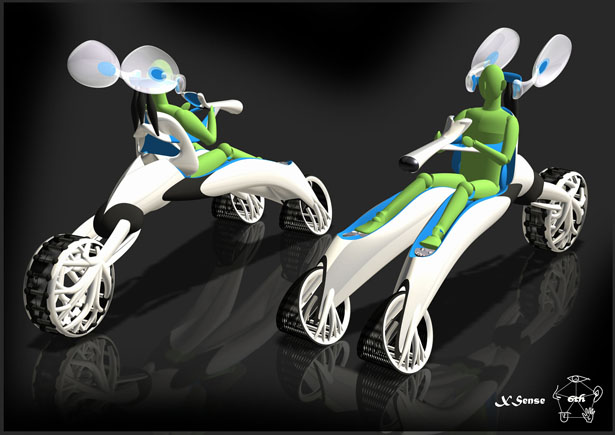
The three wheeler Robot taxis can transport two person as a part of a smooth public transportation system. This compact and slick taxies resembles with the driver’s cab of a crane driver and features uplifting door for the entry of the passengers.
8 most handy robot designs
8. Cargonaut
Urban transit will become easier than ever by enabling people get rid of their loads through cargonaut robot. This robot will help carrying heavy luggage, groceries, shopping bags and many more letting the user to be free to roam and enjoy.
8 most
 handy robot designs
8 most
 handy robot designs

space future 0

Robo tech | 3:42 AM | ,


ABSTRACT
Since the beginning of the 1960s, space tourism has been investigated world-wide. NASA has just finished a space tourism feasibility study in co-operation with the Space Transportation Association with promising results. In Japan, different space tourism scenarios are investigated in the context of industrial research for about 10 years with respect to the transportation and accommodation of tourists. In Europe and Germany, space hotel concepts are investigated and several studies analyse future advanced low cost space transportation systems which represent the key technology to make future space tourism affordable for the public. This wide variety of studies indicates, that space tourism is considered to have a considerable economic potential in the mid to long-term. Currently, tourism on Earth represents one of the biggest industrial sectors with an annual market volume of about $3400 Billion (estimate for the year 1995). If it would be possible to shift only a few percent from this amount to a future space tourism market, the size of the global civil space industry could be doubled (for comparison: presently, the global, civil, governmental space budgets amount to about $30 Billion). In this context it is notable, that initial national and international market research analyses indicate, that e.g. 4.3% of the Germans are willing to spent an annual salary for a holiday-trip into space (several $10000). Because of the presently very high space transportation costs in the order of several $10 Million, space tourism will not be feasible in the short-term due to the fact that it is not affordable. However, suborbital flights - perhaps already in the next decade - could represent precursor activities which allow a short stay in space by ascending vertically into space or by landing after one Earth orbit at the departure airport. In this case, the target "ticket prices" are in the range of $10.000 to $100000 comparable in the best case with a Concorde flight from Europe to America. Furthermore, this study presents possible future space transportation concepts of the next generations, which have a significant cost reduction potential and could allow a "space-ticket" price into Earth orbit in the range of a few $100000. These space transportation systems are fully reusable and have very high launch rates, comparable to the operation of present aircraft-fleets within the commercial airline business. The $1 billion effort of NASA's X-33 development program also aims in this direction. Furthermore, this study discusses the economic feasibility of future tourism on the Moon and Mars and presents the Space Hotel Berlin and Space Hotel Europe concepts, which allow the accommodation of about 50 tourists. TheSpace Hotel Berlin concept is mainly based on existing technologies by the use and integration of modified habitation modules (e.g. derived from COF) from the International Space Station to a ring-shaped structure. By rotating this ring-structure at different velocities, a wide variety of artificial gravity levels can be achieved. First economic analyses show that in the case of a 100% capacity utilisation, one overnight stay in the Space Hotel Berlin (without the transportation of tourists from Earth) would cost about $100000. Finally the fascinating entertainment opportunities of future space tourism are outlined.
Fig. 1: Holiday on the Moon - Already soon a Reality?
1. INTRODUCTION
According to current reports in the media, travelling to outer space should become possible for everyone by the beginning of the next century. In April 1998, the newspaper Berlin Morgenpost reported that the international Hilton Hotel corporation is planning the construction of a 5-star hotel, the "Lunar Hilton," on the Moon. A team of British architects was commissioned to develop plans for the gigantic building project. The luxury hotel with 5000 beds and a height of 325 metres provides its own beach at its private "ocean," and should be equipped with all the amenities one can expect from a first class hotel.

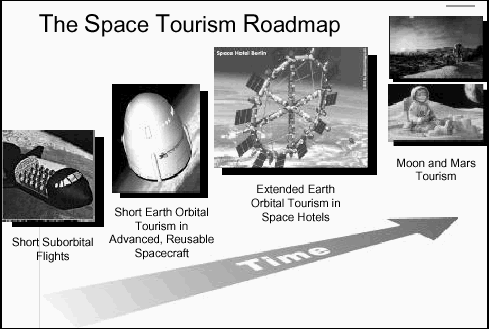
Fig. 2: The space tourism roadmap with its four sub-scenarios [ESA98, ESA99]
However, the short-term realisation of this utopian project of the Hilton Group will most likely take a little more time, and for the first half of the 21st century it must be regarded as pure science fiction. Apart from the technical feasibility of some of the construction plans, economic analyses performed by DLR and the Technical University of Berlin show that the transportation of humans and building materials to the Moon would be extraordinarily expensive, even if very optimistic economic conditions in space operations are assumed [LAssMANN94, REICHERT97a]. With the announcement of its spectacular project, the Hilton Corporation competes with three Japanese corporations, Shimizu, the construction firm Nishimatsu, and Obayashi, all of which have already invested millions into futuristic colonising concepts for the moon.
Life-cycle cost analyses performed in [ESA99, REICHERT97b/c/d] for the planet Mars indicate, that the transportation of humans would require ticket prices in the range of hundreds of millions of dollars, even if very favourable economic conditions in space operations are assumed. In addition, one must consider that after the successful completion of the Apollo program no transportation infrastructure is currently available that would allow humans to be transported beyond the Earth orbital. The creation of such a new infrastructure would require investments of billions of dollars. The Moon and Mars are therefore not likely to play a role in international tourism in the first half of the next century, although Mars represents one of the most promising travel destination because of its many similarities to Earth and its potential of possible former life forms.
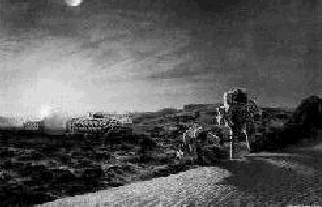
Fig. 3: The first humans explore the Martian surface
Therefore future space tourism will focus for a long time on Earth orbit which can be reached more easily. Figure 2 shows the expected roadmap for space tourism for the next decades with its four sub-scenarios. It is likely, that the space tourism business is initiated by very short suborbital flights, followed by short Earth orbital tourism in advanced, reusable spacecraft which allow several orbits around Earth. Before extended stays in space hotels will become a reality in the far future, touristic trips to existing orbital facilities (e.g. the international space station) might represent an intermediate step.
Already since the mid-sixties, several important analyses of Earth orbital space tourism have been carried out [EHRICKE67]. Various scenarios of transportation and accommodation of tourists in space have been analysed in the frame of industrial research in Japan, increasingly over the last 10 years [COLLINS97, MATSUMOTO97]. In the United States, NASA and the American "Space Transportation Association" have completed a study of the feasibility of space tourism with some promising results [O'NEIL97] in 1998. Furthermore, DASA ( DaimlerChrysler Aerospace) investigates touristic spacecraft and space hotel concepts and supported the first international symposium on space tourism in the spring of 1997, which took place in Bremen (Germany) and attracted more than 100 experts from around the world. The symposium also found a significant echo in the media. Moreover, in 1998/99, the general feasibility and economics of space tourism played also a considerable role in an ESA study under the lead of DLR [ESA98, ESA99, REICHERT98]. All of these activities indicate that space tourism is gaining more and more attention and significance. Today, it is already possible to book atmospheric parabolic flights in aeroplanes for the short-term simulation of zerogravity, and to reserve future passenger flights into suborbital space, even though the technology for the latter has not been developed yet.
2. THE INDUSTRIAL SIGNIFICANCE OF FUTURE SPACE TOURISM
According to an estimate of the World Travel Tourism Council, annual global expenditures in the terrestrial tourism sector amount to about 3400 billion US dollars for the year 1995. Tourism thus globally represents one of the largest industries. If it would be possible to shift only a few percent of the world-wide terrestrial tourist expenditures to a future space tourism market, this could double the civil space budgets to 60 billion dollars. This would create up to half a million new jobs also in the high technology space industry, if it is assumed that a sales volume of $50000 to $250000 creates one job.
If a space tourism business can be established in the future, the scientific and operational know-how - globally gained after decades of research and experience in manned space flight (e.g. by astronaut training centers or institutions of aerospace medicine) - could be applied to the space flight preparation and medical supervision of future space tourists. Furthermore, touristic spaceflights could be planned, controlled and monitored by existing space operation centers in Europe, the USA or Russia. As soon as a space tourism market is established, large commercially oriented industrial conglomerates will cooperate in strategic alliances to operate and expand the space tourism business comparable to the terrestrial tourism and telecommunications industries. The main motivation for an industrial investment in the space tourism sector will be the potential of very high achievable profits, which can be expected due to multi-billion dollar market potential.
3. THE MARKET FOR SPACE TOURISM
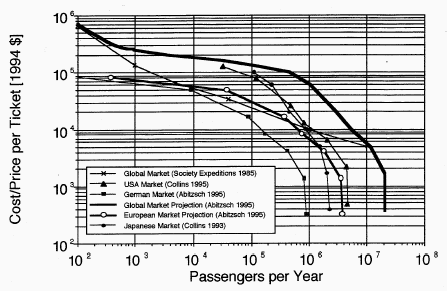
As soon as the "space ticket" can be purchased for some $10000 - in the best of all cases a ticket price comparable to that of a transatlantic flight with the Concorde - one can expect that a global space tourism market will be established. This has been confirmed by first national and international polls and market analyses (e.g. in the US, Japan, Europe) which indicate that a remarkable segment of clients would be already willing to make considerable financial commitments for short trips into space. For example, 4.3% of all Germans are willing to pay several $10000 - which is roughly comparable to an annual income - for a space trip [ABITZSCH97]. This could be a ticket price which might be achievable with future generations of spacecraft, and it is comparable to the cost of a vacation on a cruise ship which already attracts a steady clientele. Figure 4 shows the expected number of passengers for a space trip as a function of the ticket costs according to international polls performed in the US, Japan, and Europe. With current costs of several ten million dollars to transport a human into space, space tourism is not affordable and finds no acceptance in the public.
However, with declining space travel ticket prices the situation will change. Once a ticket price of $ 1000 is obtainable, a passenger volume of about 20 million is expected, and even with a ticket price of $ 50000 a passenger rate of 1 million per year can be expected. [ABITZSCH97]. Nevertheless, the above mentioned polls have to be critically assessed with respect to their accuracy and credibility. Therefore, more detailed and representative polls and market research in this area have to be carried out.
Fig. 4: Expected passengers as a function of the cost/price per ticket [ABITZSCH97]
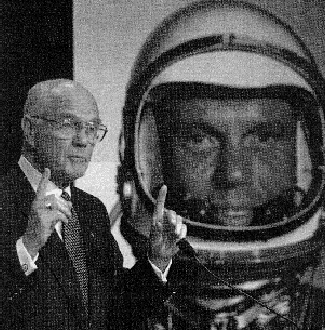
Generally, any average person in good health and with appropriate preparation is able to go on a space trip. NASA, for example, just recently decided to send 77-year old former astronaut and Senator John Glenn into space with the Space Shuttle (Fig. 5). He took part in important medical research experiments from which especially the older generation will profit.
Fig. 5: A space trip at the age of 77 years: Ex-astronaut and US-Senator John Glenn [NEWSWEEK]
4. FUTURE MANNED SPACE TRANSPORTATION SYSTEM
The fact that tourist space travel has not been established yet is mostly due to the high costs of manned space travel. The transportation of a passenger into orbit, for example with the Russian rocket launcher Soyuz still costs several $10 million. Therefore, alternative and less expensive space transportation system concepts have to be identified.
Already in 1979, a manned Space Shuttle was proposed in [DURST79], with a cabin module designed to offer a seat capacity for 74 passengers (fig. 6). The costs for this design were calculated in 1997 to be $3.6 million per passenger, assuming a launch rate of 12 flights per year [KOELLE97].
Fig. 6: A modified Space Shuttle with a seat capacity of 74 Passengers [DURST79]
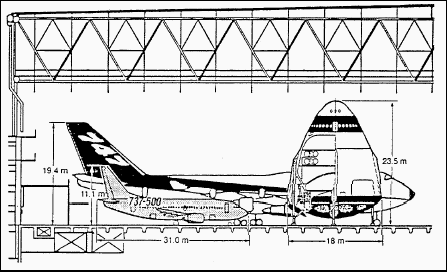
A further reduction of the costs is only expected by the development of advanced, reusable single-staged spacecraft. An example of such a spacecraft is the Japanese design for the single staged Kankoh-Maru launcher (fig. 7) [COLLINS97]. This model with a capacity of 50 passengers is propelled by oxygen/hydrogen engines and is supposed to be operated like regular airplanes on conventional airports.
Fig. 7: The Japanese Kankoh-Maru single stage vehicle in comparison with a Boeing 737 and 747 aircraft [COLLINS97]
The launch costs for this design are estimated in [KOELLE97] to be $300000 per passenger (assuming 10 launches per year) and and in [ESA98] to be about $50000 to $100000 (optimistically assuming 1 launch per day). The illustration shows the Japanese single staged launcher in comparison to a Boeing 747 and 737.
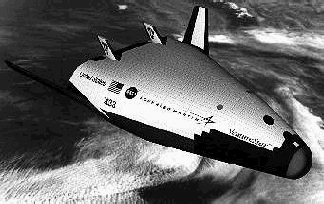
A further considerable cost reduction - ticket prices ranging from $10000 to $100000 - can therefore be only expected by the development of future generations of launchers, which have extremely high launch rates, are fully reusable and are operated with a minimum maintenance effort, comparable to today's aircraft fleets in the commercial airline business. The X-33 Space Shuttle Successor (fig. 8) - a one billion-dollar development program initiated by NASA, can be considered as a first step to lower the transportation cost into space by using a single stage to orbit launching system for the first time.
Fig. 8: The American X-33 concept [NASA]
According to the American company Zegrahm suborbital flights will play a major role, already in the next decade, as a precursor to initiate touristic space trips. These short space trips either consist of a vertical ascent into space or end after one orbit around Earth with a landing at the departure airport. Although the advanced technology for suborbital flights is not developed yet, it is already possible to make reservations for such space trips for the beginning of the next decade at a ticket price of about $100000. However, the past experience shows, that the new development of high technology launchers generally requires long periods of research and testing and also investments typically in the range of several billion dollars. Taking these circumstances into account, the cost calculations and especially the short time frame for the first suborbital flights already for the beginning of the next decade appears very optimistic. Moreover, the first X-prize (promising $10 million prize for the first private manned rocket, which is launched to an altitude of 100 kilometer) candidates ran out of business.
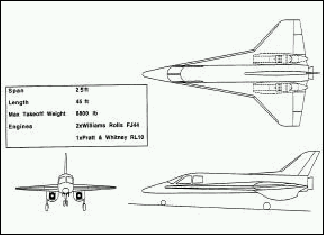
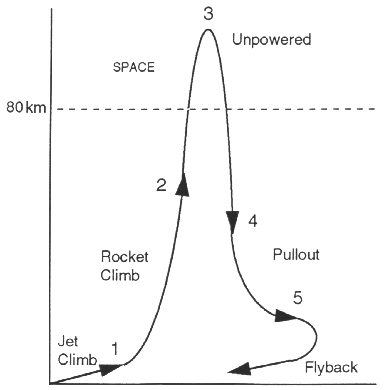
Another project aims at the same objective: the proposed Ascender spaceplane (fig. 9) which is designed to perform several flights per day with a crew of 4 members. Ascender is equipped with two Williams-Rolls FJ44 turbofans and a Pratt & Whitney RL10 rocket engine. After take-off from a conventional runway it performs a subsonic ascent to an altitude of 8 kilometre on jet power by using its two turbofans (fig. 10). Afterwards the rocket engine is ignited which lifts the spaceplane to an altitude of about 100 km. After re-entry into the atmosphere the spaceplane returns to the departure runway. The price per passenger is estimated [ASHFORD97] to be $ 5000 within the next 10 to 20 years. This cost estimate must be critically assessed, and appears too optimistic, especially in comparison with military jets with one flight hour costing up to several $10000. Furthermore, up to now, the RL10 rocket engine is not designed to be operated fully reusable and several times a day.
Fig. 9: The suborbital Ascender spaceplane [ASHFORD97]
Fig. 10: A typical ascent/descent trajectory of the Ascender spaceplane [ASHFORD97]
This might significantly increase the cost per flight and indicates that a costly development program has to be initiated to modify the RL10 engine according to the requirements of the Ascender spaceplane. Finally, Ascender's maximum take-off weight of only about 4000 kg seems very optimistic and too low to fulfil the mission requirements. Nevertheless, the general Ascender spaceplane approach looks promising and could result in an important technological development program, which leads to a single stage to orbit precursor spacecraft for Europe.
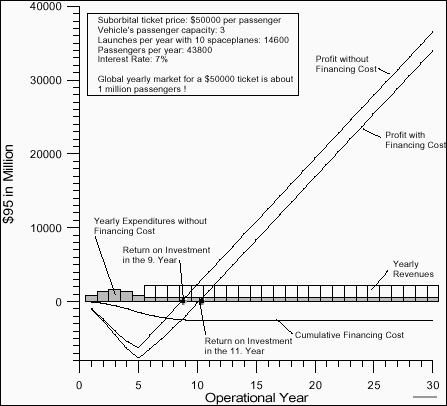
For this reason a first rough return on investment analysis has been carried out for the suborbital scenario in [ESA98, ESA99]. Space tourism is expected to be carried out by commercial companies which expect a profit from their business. Furthermore, in general, initial investments for the development and production have to be refinanced. Figure 11 shows the profit as a function of the operational year including and excluding financing costs, assuming a fare per passenger of $50000. If the financing costs are neglected, a first profit can be achieved in the 9th operational year which increases to about $36.6 billion in the 30th operational year. Considering financing costs, the date of the first profit shiftes to the 11th year and increases to about $34 billion in the 30th operational year. This decreased profit is caused by financing costs, which sum up to about $2.5 billion within the 30 year life cycle. The date of the first profit could be even shifted to earlier years, if the repayment of the development and production costs is spread over a longer period. Because of the relatively early return of i nvestment and the high achievable profits, the suborbital flights scenario generally looks very promising from an economic standpoint. This is also confirmed by the fact, that international polls ind icate, that the assumed ticket price of $50000 could lead to more than one million passengers per year [ABITZSCH97]. Due to the fact, that the fleet of 10 spaceplanes is only capable of transporting 43800 passengers per year, a further extension of the suborbital flights business seems very likely with decreasing ticket costs. However, it should kept in mind that the achieved profit mainly depends on low operation costs per flight (currently not state of the art) and the ability to realise the Ascender spaceplane with very low mass budgets as designed by [ASHFORD97].
Fig. 11: Return on investment analysis for the suborbital flights scenario [ESA98]
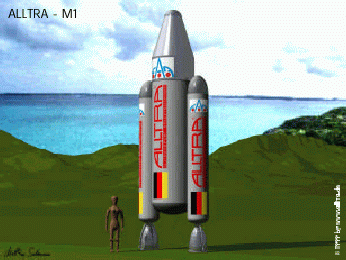
A completely different design approach is implemented in the concept of the single stage ALLTRA-M1 rocket (fig. 12) of the German FAR research group, which could also represent a promising X-prize candidate [FAR99]. A capsule, which can accommodate up to 3 crew members is mounted on top of the rocket, which is able to reach an altitude of at least 100 kilometres during a vertical ascent. The ALLTRA-M1 rocket has a total mass of only about 10 tons and has almost the dimensions of a garage. The rocket is equipped with a hybrid propulsion system, in which liquid oxygen (in the central tank) is burned up with ordinary solid plastics in the lateral boosters. The hybrid propulsion system represents an interesting propulsion alternative between the classical solid and liquid/liquid propulsion systems. Its simple design, generous production tolerances and environmentally friendly and inexpensive fuels, possibly produced from recycled materials, make them a good candidate for low-cost high power propulsion systems. Thus a complete refuelling of the ALLTRA-M1 rocket costs only about $5000 and a 2-staged rocket concept could even reach a stable orbit around Earth. However, the overall economy, the atmospheric re-entry with acceptable G-loads, the soft landing and the general reusability still have to be demonstrated for the ALLTRA-M1 rocket in further studies.
Fig. 12: The ALLTRA-M1 hybrid rocket [FAR99]
5. TOURISM IN SPACE HOTELS
In order to provide longer touristic stays in Earth orbit, concepts for space hotels have been investigated world-wide. In Japan, several designs for large-scale space hotels were analysed in the context of industrial studies like the Shimizu space hotel illustrated in fig. 13 [MATSUMOTO97]. It has a total mass of 8000 tons and offers all amenities and entertainment opportunities, one can expect from such a giant hotel complex. It is difficult to imagine from a current standpoint, that this giant hotel complex can be financed, built up and constructed in the near future. However, this sophisticated hotel concept might represent the second generation of space hotels maybe in the second half of the 21st century.
Fig. 13: The Japanese space hotel concept by Shimizu [MATSUMOTO97]
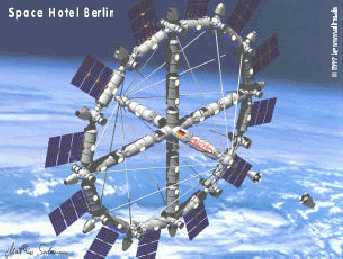
A different design philosophy is considered in the Space Hotel Berlin concept (fig. 14), which was evaluated to some extend at DLR in the context of an ESA study [ESA98, ESA99]. For this concept, mainly existing technologies are used by connecting modified habitat modules derived from the International Space Station (e.g. COF) as "apartments" to a circular ring-structure.
Fig. 14: The rotatingSpace Hotel Berlin concept in Earth Orbit [REICHERT98, ESA99]
Rotating the circular structure with different velocities, creates a wide variety of artificial gravity levels. With regard to mass and costs, the Space Hotel Berlin is about comparable to the International Space Station . In case of a 100 percent rate of capacity utilisation, first rough life cycle cost analyses indicate that the accommodation of tourists seems possible at a price of about $100000 per overnight stay. This depends on the assumed life time of the space hotel complex, ranging from 10 to 30 years [ESA98, ESA99]. However, these costs do not include financing cost (for prefinancing the development and production phase), a profit for a commercial company and the expensive Earth to LEO transportation of the tourists. This means, that a space hotel can be realised at the earliest, as soon as future generations of launchers provide extreme cost-efficient tickets, which are decreased by a factor of about hundred. Moreover, a further reduction of the space hotel's costs have also to be achieved by a more optimised design.
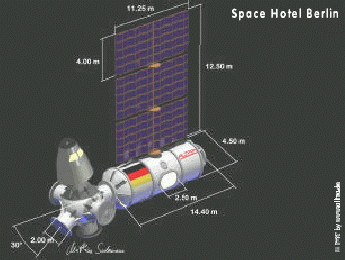
Figure 15 shows the major subsystems of one basic element, of which the Space Hotel Berlin concepts consists during the first build-up phase. The central subsystem is a cylindrical "apartment"-module with a large panoramic window which is capable to accommodate about 4 tourists. Connected to the module is a solar array which provides in combination with a rechargeable battery pack sufficient electrical energy for the flight phases when the space hotel enters into the Earth's shadow for about 40 minutes. Furthermore, a multifunctional connecting node, which can be entered by humans, is docked at the apartment module. This node provides five further docking ports which can be used, if needed in subsequent build-up phases, to connect additional apartment modules. For safety reasons each node has its own rescue capsule, which can be used in emergencies for the immediate return of the tourists back to Earth. With respect to the main apartment axis, the connecting node is 30o aligned, which causes the circular structure of the Space Hotel Berlin with a capacity of about 50 tourists.
Fig. 15: The basic element of the Space Hotel Berlin concept [REICHERT98, ESA98]
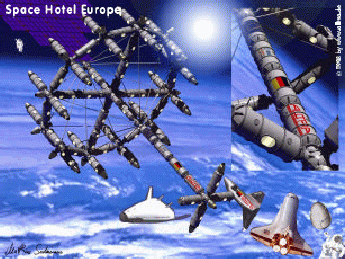
Figure 16 shows an artist view of the Space Hotel Europe concept, which is derived from the circular structure of theSpace Hotel Berlin to simplify the rendezvous/docking manoeuvres and to improve the living conditions.
Fig. 16: TheSpace Hotel Europe concept [ESA99]
6. THE FASCINATION OF SPACE TRAVEL
The fact, that a significant portion of the public is willing to spend a lot of money on space trips proofs that these are regarded as very promising and fascinating. The confrontation with the high technology of space missions, the heroic myth of astronauts, and the possibility of orbiting planet Earth in just a little more than 80 minutes with a speed of about 30000 kilometres per hour (compared to the 80 days needed a hundred years ago) will represent for each tourist an unforgettable adventure and event. Furthermore, for the first time in his life, the tourist in a space hotel will experience an entirely different environment. Depending on the rotational velocity of the Space Hotel Berlin various levels of artificial gravity can be obtained, ranging from customary terrestrial gravity (1G) to Mars gravity (1/3 G) and even Lunar gravity (1/6 G), i.e. a human being will weigh only one sixth of his or her earthly weight. In the central node of the Space Hotel Berlin there will be nearly zero gravity. Here the tourist can experience weightlessness. How does one behave if one can not get from A to B in a normal way and "above" or "below" are without meaning. Many of the questions that astronauts were asked - how they manage eating, sleeping, and personal hygiene - can be explored by tourists themselves. The zerogravity area also offers fascinating opportunities for entirely new sorts of entertainment, games and sports. For example a ball game in zero-gravity and three-dimensional space. Or one can imagine a swimming pool. The water would not be in a basin, but would float as wobbly water bubbles in space, some of which are several meters in diameter, and one can swim and dive through them. One can imagine that some tourists may want to use the zero-gravity zones for future medical therapies: This could represent a first step towards a future space hospital. Furthermore, the Coriolis force, which only appears within rotating systems, will baffle the tourist, since it will push him, like a magic force, into a certain direction, depending on his direction of movement. Probably, the predominant part of the vacation will be spent with the breathtaking view each tourist will have from the panoramic window of each apartment onto the blue home planet from a distance of 400 kilometres. Even if initially concentrating on his home city and country, soon the tourist will discover earth with its thin and precious atmosphere and a wide variety of picturesque structures on its surface as a totality without national borders. On the other hand, the view of the infinite expanse of outer space will dramatically symbolise that we owe our human existence, history and future a singular, beautiful, tiny "grain of sand" which we call Earth.
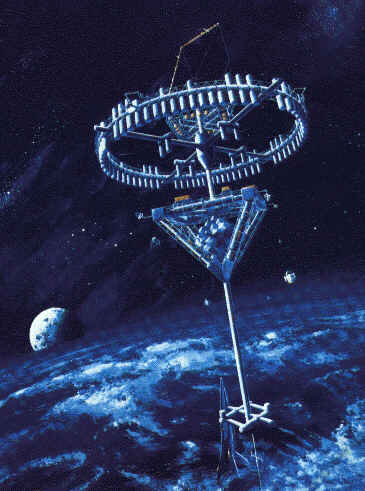
After returning to Earth, the consciousness of many tourists may have changed; it will be expanded and globalised with many potentially positive social consequences, which could help, for example, to lower the dangers for environmental pollution, local conflicts, and war. Once space tourism is affordable to the broad public, space activities - especially manned space programs - will develop and increase in a way that is hardly imaginable today. A wide variety of space station concepts have been investigated for decades (fig. 17) and first concepts for gigantic, circular cities in orbit are available. Perhaps many humans increasingly will harbour the wish to visit the more remote planetary worlds of Mars and of the Earth's Moon some day, according to the Russian space pioneer Ziolkowksy who proclaimed around the year 1900: "Earth is the cradle of humanity, but one cannot always remain in the cradle."
Fig.17: Wernher von Braun`s ring-shaped space station of 1952
The cover picture and some artist views in the text are provided by ALLTRA. You are invited to visit the complete space gallery of ALLTRA at http://www.alltra.de
7. REFERENCES
    [ABITZSCH97]   S Abitzsch, 1997, "Global Market Scenario of a Space Tourist Enterprise" , International Symposium on Space Tourism, Bremen, March 20-22, Germany.
    [ASHFORD97]  D M Ashford, 1997, "Funding the Development of a Space Tourism Industry", International Symposium on Space Tourism, Bremen, March 20-22, Germany.
    [COLLINS97]  P Collins, 1997, "The Japanese Rocket Society's Space Tourism Research", International Symposium on Space Tourism, Bremen, March 20-22, Germany.
    [DURST79]   S Durst, 1979, " The Space Shuttle as a Passenger Vehicle", AAS-Prprint 79-317.
    [EHRICKE67]  K A Ehricke, 1967, Space Tourism. Paper AAS 67-127 presented at the 13th AAS Annual Meeting , Dallas (TX), May; also: Adv. Astronautical Sci. 23 (1968), 259-291.
    [ESA98]  ESA, 1998, S&U-Study: System Concepts Architectures and Technologies for Space Exploration and Utilisation, Technical Note 2, ESA/ESTEC Contract No. 12756/98/NL/JG(SC)
    [ESA99]  ESA, 1999, S&U-Study: System Concepts Architectures and Technologies for Space Exploration and Utilisation, Final Report, ESA/ESTEC Contract No. 12756/98/NL/JG(SC)
    [FAR99]  FAR - Forschungsgruppe Alternative Raumfahrt konzepte / Research Group on Alternative Space Flight Concepts (1999), Internet webpage: http://www.optipoint.com/far/home.htm
    [KOELLE97]   D E Koelle, 1997, " Technical Assessment of the Minimum "Cost per Flight" Potential for Space Tourism", International Symposium on Space Tourism, Bremen, March 20-22, Germany.
    [LAssMANN94]  J Lassmann, 1994, Ein Modell zur Simulation der Personentransportkosten im cislunaren Bereich, VDI Fortschrittberichte, Reihe 16/Nr. 74, VDI Verlag, ISBN 3-18-307416-8.
    [MATSUMATO97]  S Matsumoto, 1997, " Orbital Hotel Concepts", Shimizu Corporation, International Symposium on Space Tourism, Bremen, March 20-22, Germany.
    [O'NEIL97]   D O'Neil et al, 1997, "General Public Space Travel and Tourism - Volume 1 Executive Summary" by NASA and Space Transportation Association.
    [REICHERT97a] M Reichert, M Klimke, D Koenies and W Seboldt, 1997, Was kommt nach der internationalen Raumstation? Wissenschaftliche, technische und o"konomische Aspekte bemannter Mond- und Marsmissionen, Vortrag auf dem Deutschen Luftund Raumfahrtkongress 1997 in Mu"nchen.
    [REICHERT97b] M Reichert, 1997, " Cost-Benefits for Future Space Programs by Using Lunar and Martian Propellants", European Space Agency, Paris, Report No. ESA-TT-1350.
    [REICHERT97c] M Reichert and W Seboldt, 1997, " What does the first Manned Mars Mission Cost? - Scientific, Technical and Economic Issues of a Manned Mars Mission", International Astronautical Federation, paper no.: IAA-97-IAA.3.1.06, IAF-Congress, October 1997, Turin, Italy.
    [REICHERT97d] M Reichert, 1997, " What does the Ticket cost?", Technical and Economic Issues of Future Space Tourism, International Symposium on Space Tourism, Bremen, March 20 - 22, 1997.
    [REICHERT98]  M Reichert, 1998, "The Future of Space Tourism", ESA Workshop on Space Exploration and Resources Exploitation (ExploSpace), Cagliari, Sardinia, Italy, Oct. 98


future technology Copyright © 2010 Future tech is Designed by pavan Home | RSS Feed | Comment RSS